
Over the past decade, higher-education institutions have invested heavily in digital platforms—learning management systems, enterprise software, examination tools, and accreditation portals. Despite this, many institutions continue to face persistent challenges related to faculty workload, administrative coordination, student outcomes, and accreditation compliance. This concept note argues that the root cause is not the absence of software, but the absence of a systems view. Academic operations are typically digitized as isolated functions rather than designed as an integrated whole. The purpose of this document is to initiate discussion around the idea of an Academic Operating System (AOS)—not as a product, but as a conceptual framework for understanding, coordinating, and evolving academic operations in higher education.
1. The Fragmentation Problem in Academic Institutions Most institutions operate through a collection of disconnected processes: •Teaching and learning managed through an LMS •Assessments handled through separate tools or manual workflows •Academic records stored in administrative systems •Accreditation documentation prepared independently, often manually While each function may be digitized, the institution itself is not systematized. This leads to: •Repeated manual data entry •Inconsistent records across departments •High administrative burden on faculty •Limited visibility for institutional leadership Fragmentation, rather than lack of effort or intent, is the defining constraint.
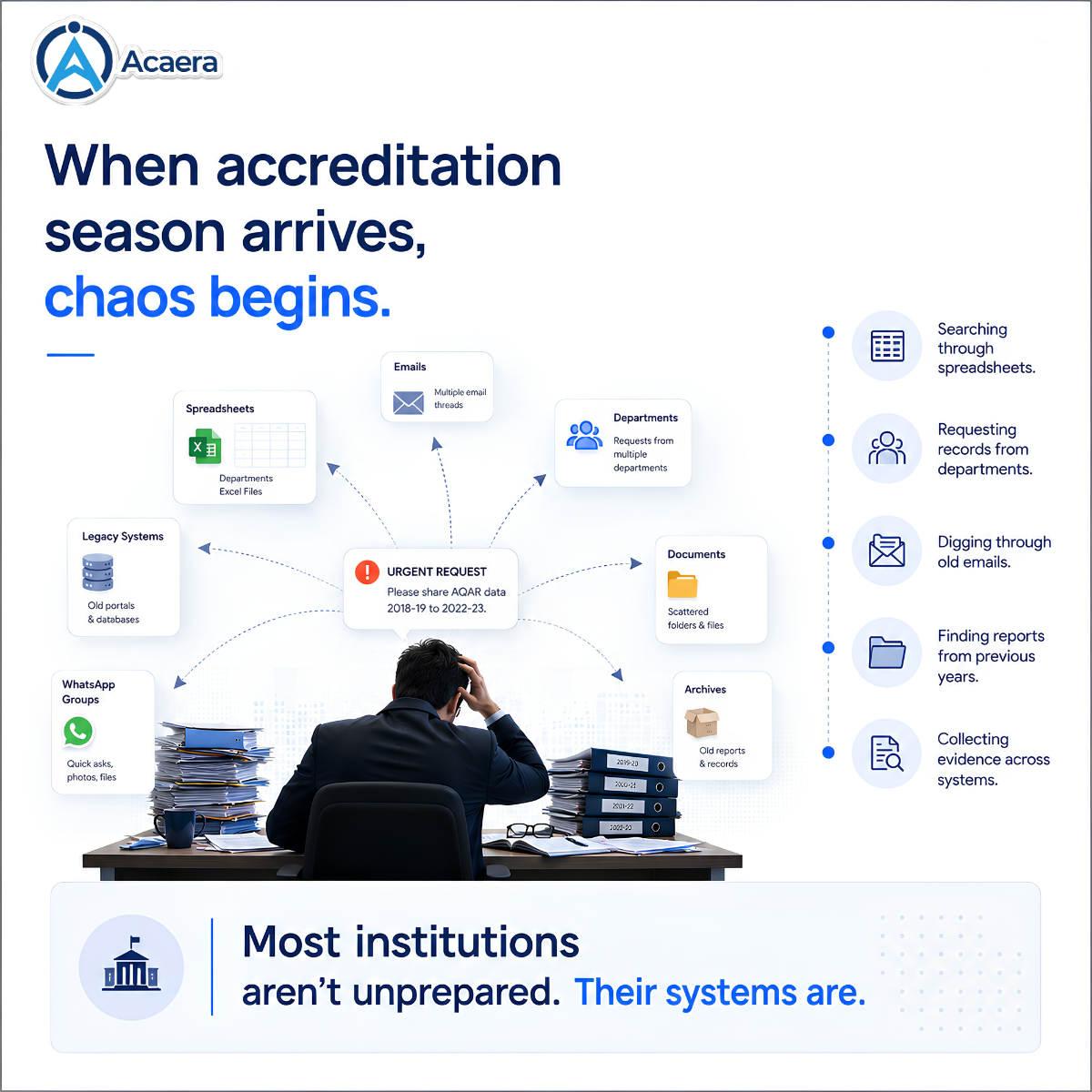
2. Limits of Tool-Based Digitization Digital adoption in higher education is often procurement-driven: •Institutions acquire tools to solve immediate problems •Each tool optimizes a local function •Integration is treated as a secondary concern As a result: •Faculty interact with multiple systems for a single academic process •Data generated in one context is rarely reusable in another •Accreditation and compliance remain documentation-heavy exercises This approach improves efficiency marginally but does not address structural inefficiency.
3. Academic Operations as a System Academic operations can be understood as a coordinated system, comprising: •Curriculum design •Teaching and learning activities •Assessment and evaluation •Academic records and outcomes •Quality assurance and accreditation These are not independent functions. They are interdependent processes that produce, consume, and rely on shared academic data. Treating them separately leads to duplication and misalignment. Treating them as a system enables coherence.
4. Introducing the Academic Operating System (AOS) Concept An Academic Operating System (AOS) can be defined as: A unifying framework that coordinates academic processes, data, and governance mechanisms across an institution. Importantly: •An AOS is not a single software platform •It is an operating logic for how academic work is organized, recorded, and governed •Digital tools function as components within this logic, not as isolated endpoints
5. Core Layers of an Academic Operating System An AOS can be conceptualized across the following layers: 5.1 Academic Process Layer Teaching, assessment, evaluation, and outcome definition. 5.2 Data Layer Student performance data, assessment artifacts, learning records, and outcomes. 5.3 Digital Services Layer LMS, assessment tools, analytics platforms, and supporting software. 5.4 Governance & Compliance Layer Accreditation requirements, quality assurance, institutional reporting. 5.5 Human Roles Layer Faculty judgment, administrative oversight, and academic leadership. The value of an AOS lies in aligning these layers, not replacing them.
6. Role of Digital Platforms and AI Within an AOS framework, digital platforms and AI serve assistive roles: •Reducing repetitive academic tasks •Supporting documentation and reporting •Providing insights from existing academic data AI, in particular, should be viewed as: •Decision-support, not decision-making •Augmentation of faculty effort, not substitution •Governed by academic and institutional controls This distinction is critical for institutional trust.
7. Quality improvement and Assurance Processes such as NAAC, NBA, and NIRF reporting are often treated as external compliance exercises. From a systems perspective, they are outputs of routine academic operations. When academic processes are structured and data is coherently captured: •Accreditation documentation becomes a by-product, not a burden •Faculty effort shifts from compilation to validation •Institutional readiness improves continuously, not cyclically This reframing has significant implications for workload and governance.
8. Pilot-Informed Observations (Indicative) Early pilot experiences with digital academic tools suggest that: •Data required for accreditation already exists but is scattered •Faculty workload increases when systems are not aligned •Incremental digitization does not resolve systemic inefficiencies These observations reinforce the need for a systems-level approach rather than additional standalone tools.
9. Adoption Considerations and Boundaries Adopting an AOS perspective requires: •Phased implementation •Institutional capacity building •Clear governance structures Respect for academic autonomy •This concept does not imply: •Immediate system replacement •Centralized control over pedagogy •Automation of academic judgment Caution and context sensitivity are essential.
10. Conclusion: An Invitation for Discussion The challenges faced by higher-education institutions today are systemic in nature. Addressing them requires moving beyond tool-centric solutions toward system-level thinking. This concept note does not propose a solution. It proposes a lens. The intent is to invite discussion among faculty, administrators, and policymakers on how academic operations can be better coordinated to support quality, accountability, and sustainability.